
Running builds bone in your legs and hips. It does much less for your spine, little for your arms — though one review did find a significant increase in cortical thickness at the mid and proximal radius, so “nothing” overstates it, and there is a version of distance running that actively harms your skeleton. The most useful thing on this page is not about running at all — it is what to add alongside it, and why roughly seven in ten Indian athletes are vitamin D deficient.
What the study actually found
327 male runners averaging 29.7 km a week were compared with 212 inactive men, adjusted for age, height, mass, BMI, fat mass and lean mass:
- Legs: 1.26 vs 1.18–1.19 g/cm², p < 0.001
- Femoral neck: 0.96 vs 0.89, p < 0.001
- Hip: 1.08 vs 1.03, p = 0.001
- Whole body: 1.16 vs 1.11, p = 0.006
- Spine: 1.06 vs 1.03, p = 0.017 · Lumbar spine: 1.05 vs 0.99, p = 0.042
- Arms: no difference (p = 0.376)
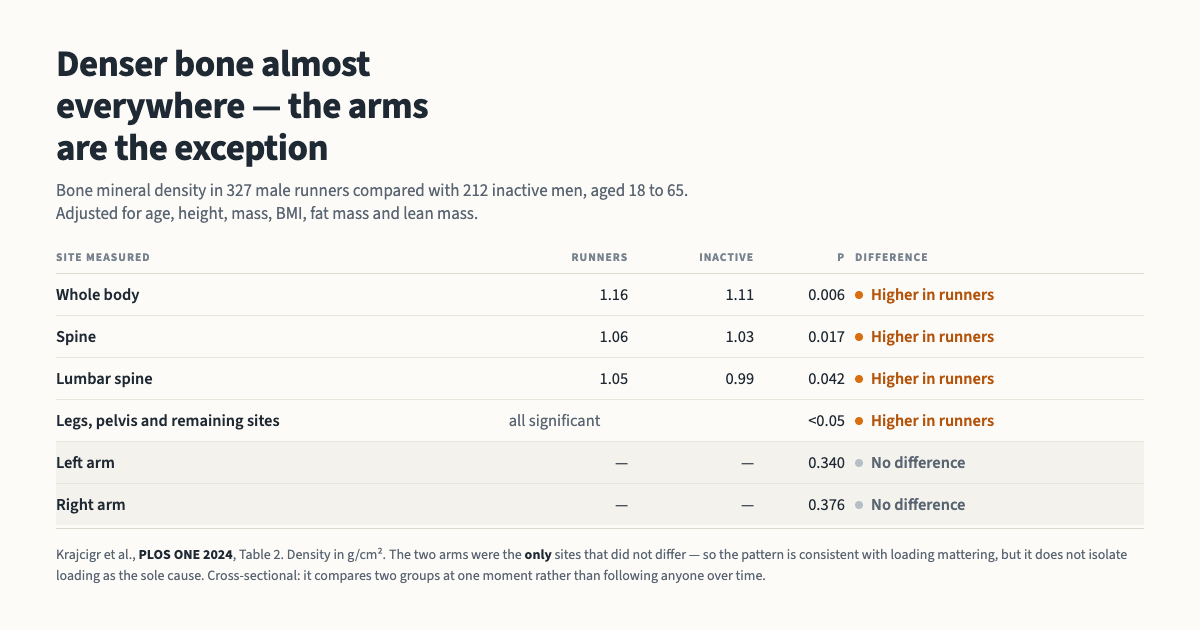
The arms are the point. They are the study’s own internal control: if runners simply had better bones because they eat better and sleep more, their arms would be denser too. They were not.
Two things the headline version leaves out. The effect shrinks with age — in the 56 to 65 group only one site still differed, and the authors note that “the increase in BMD from running decreased with age.” And this was Caucasian men only, with self-reported activity and no control for whether they also lifted weights.
The honest limit of all of this
There is essentially one randomised trial of running and bone density in adults, and it is small: 31 college women completed the whole three-arm trial, so the jogging group was around a third of that. Over eight months the joggers gained 1.3 ± 1.6% at the lumbar spine. Note that the standard deviation is larger than the mean — some participants lost bone. Everything else in this area is extrapolated from studies of jumping, hopping or resistance training.
And the trial evidence for exercise and adult bone is far weaker than the cross-sectional athlete comparisons suggest. A meta-analysis of ten supervised trials lasting at least six months, measuring whole-bone strength rather than density, found:
- Pre-pubertal boys: SMD 0.17 (0.02 to 0.32)
- Premenopausal women: SMD 0.00 (−0.43 to 0.44)
- Postmenopausal women: SMD 0.00 (−0.15 to 0.15)
Exactly zero, twice. The same research group produced both the impressive athlete cross-sections and this null. That gap — between what athletes look like and what training actually delivers to an adult — is the single most important honest point here.
There is also a measurement trap. Bone remodels on a cycle of roughly one month of resorption and four to five months of formation, so nothing real can be measured before about six months. And filling in the temporary hole left by that process can produce apparent gains “as large as 30% or more” that are not new bone at all.
Where distance running goes wrong
This is the part rarely mentioned on running websites.
In 109 endurance runners, 36% of men and 42% of women had lumbar spine T-scores below −1.0. Weekly distance was negatively correlated with spine density in both sexes (p < 0.001), independent of menstrual status. In another study, male runners had 9% lower lumbar spine density than non-athletes.
Among master athletes, sprinters had hip density 10% higher than endurance runners — and “there were no differences in hip or spine BMD between endurance runners and controls.”
Two things stop this becoming a scare story, and both matter.
First, always quote the control group. The widely cited finding that 40% of runners had osteopenic spines comes from a study in which 34% of the sedentary controls did too, including 7% below −2.5. The runners were barely worse than the couch.
Second, and more decisively: when researchers compared 20 elite male runners against controls matched for age and BMI — testing whether the whole effect is just runners being light — the runners came out with “significantly higher BMD at all loaded sites (calcaneus, lower limbs, femoral neck, pelvis, and trabecular lumbar spine).” Their conclusion: “The effect of long distance running per se on bone parameters is not deleterious.”
And no study has ever identified a mileage threshold beyond which running harms bone. The volume findings contradict each other outright: one found a negative correlation, another found the correlation vanished after adjusting for age, BMI and body fat, and a third found a positive one.
The thing that actually damages runners’ bones
It is not the running. It is not eating enough to support it.
A controlled feeding study fed women at 10, 20, 30 and 45 kcal per kg of lean mass per day and measured bone turnover:
- Bone breakdown increased only at 10 — the most severe restriction
- Bone formation was suppressed at every restricted level, including 30
The authors: “Bone formation was impaired by less severe restrictions than that which increased bone resorption.”
So the common claim that “below 30 kcal/kg you start losing bone” is not right. Thirty is where you stop building it. That is arguably worse for a young runner, because you notice nothing while it happens.
How common is this? In high-school cross-country runners: 60% of girls and 30% of boys were below that threshold.
And the injury consequences are measurable. In a prospective study of 259 exercising girls and women, low bone density combined with 12+ hours of training a week gave OR 5.1 (95% CI 2.2 to 12.1) for bone stress injury; a separate combination in the same study — 12 or more hours a week, a leanness sport and dietary restraint, without low bone density in the model — carried OR 8.7 (2.7 to 28.3).
In male runners the same pattern appears — but with a revealing twist. Runners whose energy availability was at or above the median had higher hip bone density than non-running controls (p = 0.002). The harm tracks the fuelling, not the running.
How bone actually decides to grow
The rules were worked out decades ago, and they explain why running is a mediocre bone stimulus despite involving thousands of impacts.
The response saturates almost immediately. In the classic experiment, 36 loading cycles a day raised bone mineral content to 133–143% of baseline in six weeks. Increasing from 36 to 1,800 cycles a day added nothing. In rats, five jumps a day was enough — the authors noting “a large number of strains per day is not necessary.”
Run 10 km and you deliver several thousand loading cycles. The first few dozen did essentially all the available work.
Bone responds to novelty and rate, not repetition. Static loading at physiological magnitude was indistinguishable from doing nothing at all. Cells stop responding to loads they have grown used to — which is precisely what habitual running is.
Splitting the load into bouts helps. Dividing 360 daily cycles into four to six sessions produced 65–94% more bone formation than the same number at once, with mechanosensitivity restored after about eight hours. (Honest caveat: a 2026 study splitting 50 jumps into five bouts found no advantage. This is not fully settled.)
The single most useful practical finding compares loading types in 255 female athletes:
- Odd-impact (squash, football, step aerobics — changes of direction): femoral neck +29%
- High-impact (volleyball, hurdling): +23%
- Weightlifting: not statistically significant
- Repetitive non-impact (swimming, cycling): no clear benefit
Multidirectional, unpredictable loading beat pure vertical impact on bone density — and it is mechanically gentler. Worth knowing, though: loading type explained only 13% of the variation, while height and weight together explained about half.
But that ranking reverses when you measure something other than density. When researchers built finite-element models of 91 female athletes’ hips and simulated twelve different sideways falls, endurance runners came out best — 22 to 28% higher fracture load in every fall direction, against 11–17% for high-impact athletes and only 10–11% for odd-impact athletes, and then in just four of the twelve directions.
So: by bone density, varied multidirectional loading wins. By modelled resistance to an actual hip fracture, running wins. Those are two different measurements disagreeing, and nobody has resolved it. It is a reason to do both rather than to pick.
What running does not touch
A meta-analysis of 28 randomised trials using CT and MRI rather than DXA found gains at the distal tibia (+0.54%) and proximal femur (+3.11%), and then this: “There was no effect on vBMD and bone structure at the distal radius, femoral shaft, or lumbar spine across all studies or in any subgroup.” In adults it even found a small decrease in mid-tibia cortical density.
The spine response is weak and inconsistent. We previously wrote that the spine does not respond at all — but the headline comparison in that study did find higher spine and lumbar density in runners (p = 0.017 and p = 0.042), and those results simply did not survive the confounder-adjusted, age-stratified analysis (p = 0.098). Weak and unreliable is the fair reading, not absent, and it is why the next section matters.
What to add
Resistance training. This is what the meta-analyses actually support. Cochrane’s best result for the femoral neck came from progressive resistance training, not impact work; the best spine result came from combined programmes. A high-intensity trial in postmenopausal women with low bone density produced +2.9% at the spine versus −1.2% in controls (p < 0.001) from twice-weekly sessions over eight months, with one minor adverse event.
In runners specifically, those doing resistance work at least twice a week had spine T-scores of −0.4 and −0.5 against −1.1 for those who did not (p < 0.01).
Short, sharp, multidirectional jumping. The UK consensus statement recommends about 50 impacts per session — five sets of ten — on most days, with resistance work at a load you can lift 8 to 12 times, two or three days a week. Note how small that is. It is a few minutes, not a session.
Eat enough to support the training. This has the clearest mechanism, the clearest dose-response, and an intervention behind it: adding 5.1 MJ a day to soldiers on an arduous course moved a bone formation marker from −4.4 to +16.0 µg/L (p < 0.001).
The Indian part, which is the actionable part
This is where a Gurugram runner should actually spend their attention.
Vitamin D. In 369 healthy North Indian athletes aged 18 to 45: 69.9% deficient, 13.8% insufficient, and only 16.3% sufficient. Thirty per cent had low bone density — and 95% of those were vitamin D deficient. Being an athlete in India confers no protection.
Part of the reason is when we train. Skin synthesis of vitamin D at Indian latitudes peaks between 11 a.m. and 2 p.m. A club that runs at dawn and works indoors gets very little.
Calcium. The ICMR recommendation is 1,000 mg a day. Measured intakes in Indian adults run at 268 to 526 mg depending on region — roughly a third of the requirement.
But do not overdo the vitamin D. A three-year randomised trial comparing 400, 4,000 and 10,000 IU daily found bone density at the wrist fell progressively with dose: −1.2%, −2.4% and −3.5%. More is worse. And in people who are already replete, supplements do essentially nothing for fractures — across 36 trials and 44,790 people, RR 1.00 (0.93 to 1.07).
The distinction is everything: correcting a deficiency is a different thing from supplementing someone who is fine. Given that seven in ten Indian athletes tested were deficient, getting a blood test is more useful than reading either side of that argument.
One more thing worth knowing before anyone panics about a scan result. In 238 Indian men, 26.4% were classified osteoporotic using the built-in Caucasian reference database and 2.8% using the Indian one. Sixty per cent of the “osteoporosis” cases were reclassified as osteopenia. Ask which reference your scan used.
And there is no published study of bone density in Indian runners at all.
Two things about stress fractures
The strongest predictor of a bone stress injury is having had one before: OR 4.99 (95% CI 2.91 to 8.56), with no heterogeneity between studies. Female sex is second, OR 2.31 (1.24 to 4.29).
Notably, bone density itself failed to predict stress fractures in two separate prospective studies of runners. It is a population risk factor, not an individual crystal ball.
The one solid prevention result: 5,201 female navy recruits given calcium and vitamin D daily had 20% fewer stress fractures (5.3% vs 6.6%, p = 0.0026).
Do not get a scan to track your running
A DXA scan’s smallest detectable change is around 5.0 to 5.3%. Exercise effects are 1 to 3%. A repeat scan physically cannot detect whether your training is working.
DXA also measures area rather than volume, which systematically penalises smaller, lighter people — a real problem for runners. And it understates loading benefit in the other direction: in animals, 5–12% density gains accompanied 64–165% gains in actual bone strength.
Get a DXA if you have risk factors and a clinician wants one. Not to audit your mileage.
The short version
- Running builds bone in the legs and hips. It does little for the spine and nothing for the arms.
- No randomised trial of running and bone density in adults exists, and trials of exercise in adult women show effects of exactly zero on bone strength.
- Bone stops responding after a few dozen loading cycles. Your long run is not a bone stimulus; a few jumps are.
- Add resistance training and around 50 varied jumps most days. That is what the evidence supports for the spine and hip.
- Under-eating harms runners’ bones far more than running does, and formation shuts down before breakdown starts.
- In India, get vitamin D and calcium checked. Seven in ten athletes tested were deficient. Do not take megadoses.
If you have had a stress fracture, are restricting food, or have missing or irregular periods, see a doctor rather than adjusting your training alone. Those are the situations where this stops being about running.
References
- Krajcigr M, et al. Comparison of bone mineral density of runners with inactive males: a cross-sectional 4HAIE study. PLOS ONE, 2024;19(8):e0306715. doi:10.1371/journal.pone.0306715
- Nikander R, et al. Targeted exercise against osteoporosis: a systematic review and meta-analysis for optimising bone strength. BMC Med, 2010;8:47. doi:10.1186/1741-7015-8-47
- Nikander R, et al. Loading modalities and bone structures at nonweight-bearing upper extremity and weight-bearing lower extremity. J Bone Miner Res, 2005;20(3):520–8.
- Rubin CT, Lanyon LE. Regulation of bone formation by applied dynamic loads. J Bone Joint Surg Am, 1984;66(3):397–402.
- Umemura Y, et al. Five jumps per day increase bone mass and breaking force in rats. J Bone Miner Res, 1997;12(9):1480–5.
- Robling AG, et al. Recovery periods restore mechanosensitivity to dynamically loaded bone. J Exp Biol, 2001;204:3389–99.
- Hind K, Truscott JG, Evans JA. Low lumbar spine bone mineral density in both male and female endurance runners. Bone, 2006;39(4):880–5.
- Fredericson M, et al. Regional bone mineral density in male athletes. Br J Sports Med, 2007;41(10):664–8.
- Piasecki J, et al. Comparison of muscle function, bone mineral density and body composition of early starting and later starting older masters athletes. Arch Osteoporos, 2018;13(1):72.
- Kemmler W, et al. Exercise effects on bone mineral density in elite male runners. Eur J Appl Physiol, 2006;96(1):78–85.
- Ihle R, Loucks AB. Dose-response relationships between energy availability and bone turnover in young exercising women. J Bone Miner Res, 2004;19(8):1231–40.
- Barrack MT, et al. Higher incidence of bone stress injuries with increasing female athlete triad-related risk factors. Am J Sports Med, 2014;42(4):949–58.
- Haines MS, et al. Male runners with lower energy availability have lower bone density. J Clin Endocrinol Metab, 2023;108(10):e1063–73.
- Ng CA, et al. Effects of moderate- to high-impact exercise training on bone structure across the lifespan: a systematic review and meta-analysis. J Bone Miner Res, 2023;38(11):1612–34.
- Watson SL, et al. High-intensity resistance and impact training improves bone mineral density in postmenopausal women with low bone mass (LIFTMOR). J Bone Miner Res, 2018;33(2):211–20.
- Brooke-Wavell K, et al. Strong, steady and straight: UK consensus statement on physical activity and exercise for osteoporosis. Br J Sports Med, 2022;56(15):837–46. doi:10.1136/bjsports-2021-104634
- Wright AA, et al. Risk factors associated with lower extremity stress fractures in runners: a systematic review with meta-analysis. Br J Sports Med, 2015;49(23):1517–23.
- Lappe J, et al. Calcium and vitamin D supplementation decreases incidence of stress fractures in female Navy recruits. J Bone Miner Res, 2008;23(5):741–9.
- Gupta R, et al. Vitamin D deficiency and bone mineral density in North Indian athletes. Indian J Community Med, 2021;46(3):559–61.
- Burt LA, et al. Effect of high-dose vitamin D supplementation on volumetric bone density and bone strength. JAMA, 2019;322(8):736–45. doi:10.1001/jama.2019.11889
- Singh SK, Patel VH, Gupta B. Comparison of Indian and Caucasian reference databases for bone mineral density. J Clin Densitom, 2019;22(1):47–51.
- Snow-Harter C, et al. Effects of resistance and endurance exercise on bone mineral status of young women: a randomized exercise intervention trial. J Bone Miner Res, 1992;7(7):761–9.
- Abe S, et al. Effect of exercise loading on hip fracture load: a finite element modelling study in female athletes. Bone, 2022;158:116351. doi:10.1016/j.bone.2022.116351
- Heaney RP. The bone-remodeling transient: implications for the interpretation of clinical studies of bone mass change. J Bone Miner Res, 1994;9(10):1515–23.